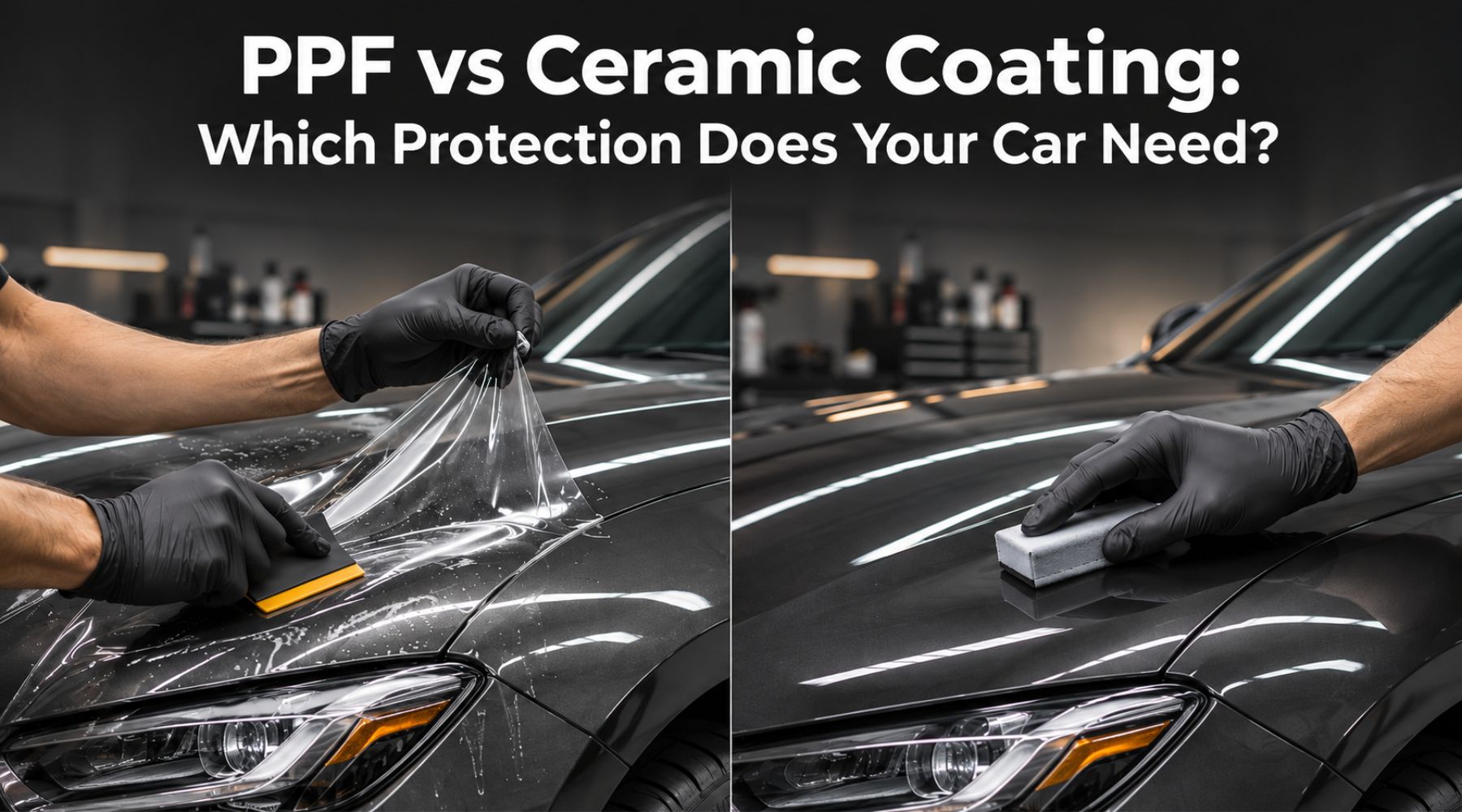
PPF vs Ceramic Coating: Which Protection Does Your Car Need?
PPF VS CERAMIC COATING • QUICK ANSWER
AUSTIN, TX
Choose protection for the problem you want to solve.
If you are choosing between paint protection film (PPF means paint protection film: a physical protective film applied to selected vehicle surfaces.) and ceramic coating, think about what you want to protect your car from. PPF is a physical barrier that helps shield painted panels from rock chips and minor abrasions. Ceramic coating is a much thinner surface treatment that repels water, makes many contaminants easier to wash off, and can enhance the paint's appearance.
Neither makes your vehicle scratch-proof or immune to damage. For Austin drivers, the choice often comes down to whether rock chips or everyday cleaning are the bigger concern. Both can make sense, but they are not automatically necessary together.
PPF vs Ceramic Coating at a Glance
Protection factor
PPF
Ceramic coating
What it is
Transparent protective film
Thin surface treatment
Rock chips
Helps absorb small impacts
Not engineered for impact
Light scratches
Some films resist or self-heal mild topcoat marks
May resist light marring; no self-healing
Water and dirt
Depends on topcoat; some films are hydrophobic
Hydrophobicity is a core benefit
Appearance
Clear gloss or matte/satin film options
Often enhances gloss
Coverage
Selected panels or broader wrap
Prepared painted surfaces in package
Preparation
Careful cleaning and paint inspection
Surface preparation; sometimes polishing
Installation factors
Panel geometry, film area, edges
Paint condition, prep, included surfaces
Ongoing care
Gentle washing; protect edges
Gentle washing; remove contamination
Best for
Rock chips and mild abrasion risk
Cleaning ease and surface appearance
If a stone strikes the hood, PPF provides a physical barrier that ceramic coating does not. If washing is your main frustration, coating may be more useful. Some PPF products already repel water, so check the specific film's features before paying for both treatments.
What Paint Protection Film Is Built to Protect
Rock chips and abrasion are its strongest use cases
PPF is a transparent, polyurethane-based film applied to the vehicle's surface. It takes the first contact from flying grit, small road debris, and incidental scuffs instead of leaving the paint directly exposed.
Forward-facing painted panels, such as the front bumper and leading edge of the hood, are common areas to consider protecting. How you drive matters, too. A car that regularly spends time on highways may face more contact with road debris than one used mostly for short city trips. That can help you decide which panels to cover first.
The film can still be cut, torn, stained, or marked. A larger or sharper impact may damage the film and the paint underneath it. Panels without film remain unprotected by it. For a closer look at available products, see XPEL’s paint protection film range.
What self-healing actually means
You may see PPF described as self-healing. On films with that feature, some shallow marks in the film's top layer can become less visible with warmth over time. It does not mean the vehicle's paint repairs itself. Deep cuts, chips through the film and other substantial damage may require a professional assessment or replacement of the affected section.
Ask what the film is designed to resist and what happens if a damaged section needs to be replaced.
What Ceramic Coating Does Better
Ceramic coating is mainly about the paint's surface behavior. Its hydrophobic properties make water bead up, and they can make road grime, bug residue, and other contaminants easier to remove during a proper wash. Results depend on the coating and the condition of the paint.
A coating may also add depth and gloss to the finish, particularly when the paint has been properly prepared beforehand.
Water repellency does not mean a car stays clean on its own. Coated paint can still collect dust, develop water spots, and pick up scratches during improper washing. Remove bird droppings, mineral deposits, and bug residue promptly. Built-up contamination can also reduce the coating's water-beading performance.
Some ceramic coatings advertise a "9H" hardness rating. That refers to pencil-hardness testing, not rock-chip resistance. It does not mean the paint is scratch-proof. A thin coating and a physical protection film serve different purposes.
If you are considering a coating, review the ceramic coating services at TX Tint and ask which surfaces each package includes. The paint may also need polishing or correction beforehand.
Match Protection to Your Priorities
Which Choice Fits Your Driving and Ownership?
Scenario 01 | Highway Driving
For a regular highway commuter
If rock chips are your biggest concern,
start with PPF. The front bumper, hood,
and other exposed panels usually deserve
the first look. Which ones to cover depends
on how you drive and your budget.
Ceramic coating may help with cleaning,
but it cannot replace a film's physical
barrier. If your budget allows only one
treatment and chips are the main concern,
PPF is the closer fit.
Scenario 02 | Easier Washing
For a driver who wants easier washing
Ceramic coating may be the better fit
if you mainly want water repellency,
a glossier finish, and easier washing.
Just remember that road debris can still
chip coated paint.
Ask about preparation before comparing
coating packages. A coating will not erase
visible swirl marks. Some paint may need
polishing first, which adds work to
the service.
Scenario 03 | Multiple Priorities
For a new or enthusiast vehicle
with multiple priorities
A combination may make sense. PPF can
cover the areas where small impacts
concern you most, while a compatible
ceramic coating can support surface
maintenance and appearance on the
coated panels.
Not every vehicle needs full-body film.
Think about where you drive, how long
you plan to keep the car, its paint
finish, and how much cosmetic wear
you are comfortable with.
Scenario 04 | Budget Priorities
For someone watching the budget
Decide what would bother you more:
a chip on the front of the car or
the time spent washing it. You could
protect selected panels with PPF,
choose a coating for easier cleaning,
or postpone one of the services.
You do not need both just because
both are available. Put your budget
toward the problem you most want
to solve.
Can PPF and Ceramic Coating Work Together?
Yes, provided the selected products are compatible. PPF helps protect the panels it covers against small impacts, while a suitable coating can improve water repellency and make cleaning easier.
Before adding coating, check whether the PPF already has a hydrophobic topcoat. XPEL offers films with built-in water-repellent properties. If you choose one of those products, a separate coating may add less cleaning benefit than you expect.
Do not assume every ceramic coating works with every film. Ask the installer to confirm the products' compatibility, expected finish, care instructions, and warranty terms before combining them.
Cost, Appearance and Maintenance: What Changes?
Why the quotes are different
A PPF quote reflects the vehicle's contours, amount of film, panel preparation and installation work. Covering only selected panels is a different project from covering nearly all the painted bodywork. Review the paint protection film options at TX Tint, including full frontal, track-oriented and full-wrap packages. The amount of coverage should be explicit in your quote.
Ceramic coating pricing is shaped by vehicle size, paint condition, polishing or correction required, the surfaces included and the coating product. Two vehicles of the same model can need different preparation. Ask exactly what is included instead of comparing a short package label.
There is no single price that fits every car or coverage package. A higher quote does not necessarily mean better protection for your needs. Compare the products, preparation, and work included.
How the finish can look
Clear PPF is intended to preserve the look of the underlying finish as closely as its construction allows. Certain film products can introduce a satin or matte appearance, which changes the visual result. Ceramic coatings generally work with the existing finish and may increase perceived gloss.
If you care about matching the finish on filmed and unfilmed panels, ask to see examples of the exact product under similar lighting. Photos may not show every difference you would notice in person.
What routine maintenance still involves
Both PPF and ceramic coating still need routine washing. Use gentle methods, remove contaminants promptly, and follow the aftercare instructions for the installed product.
Avoid aiming a pressure-washer nozzle directly at film edges; follow the manufacturer's distance guidance. On coated paint, dry rinse water before it leaves mineral spots, and remove bugs and bird droppings promptly. If the car has both systems, follow care instructions for each. XPEL’s paint protection film FAQs are a useful starting point, but your installer should explain the requirements for your specific products.
Your Paint Protection Decision Checklist
Five Questions to Ask Before You Choose
01
Which problem am I paying to reduce?
If your answer is road chips, focus on film.
If it is dirt, water behavior or appearance,
ask about coating.
02
Which panels or surfaces are included?
Do not assume a protection package covers
every painted area, wheel or trim piece.
03
What is the paint's condition now?
Existing scratches or swirls may need
inspection and preparation before
protection is installed.
04
How will the selected products work together?
Ask about compatible materials, appearance,
maintenance and what warranties actually cover.
05
What care will the car need afterward?
Get the specific first-wash and ongoing cleaning
instructions, not a generic promise of
no maintenance.
Choose Protection Based on What You Want to Avoid
Start with the problem you want to solve. For front-end rock-chip protection, consider PPF. For easier cleaning and a glossier finish, consider ceramic coating. If both benefits matter, ask how the products can work together and what each package covers.
Frequently Asked Questions
Frequently Asked Questions
Does ceramic coating protect against rock chips?
No coating should be treated as a substitute for impact-resistant film. Ceramic coating is thin and primarily valued for surface behavior, appearance and ease of cleaning. If your main concern is chips from road debris, talk to an installer about PPF on the panels most exposed to that risk.
Does paint protection film make a car easier to wash?
It can. Some PPF products have slick or hydrophobic topcoats that help water and dirt release more easily. Others prioritize the film's protective layer without the same water-repellent properties. Check the exact product instead of assuming every film behaves like a ceramic coating.
Will either option prevent every scratch?
No. PPF may resist minor abrasion and some films can recover shallow marks in their topcoat, but deeper damage can remain. Ceramic coating may offer some resistance to light marring, yet improper washing and stronger contact can still scratch a coated surface. Neither protects against every type of damage.
Is ceramic coating easier to maintain than PPF?
Ceramic coating is designed to make washing easier, although some PPF products offer similar water-repellent benefits. Both still need gentle cleaning. If your car has both, follow the care instructions for each material.
Should an Austin daily driver get both PPF and ceramic coating?
Not necessarily. If chips are your main concern, selected-panel PPF may be enough. If easier washing matters more, ceramic coating may fit better. Both can make sense when you want impact protection and water repellency, and the products are compatible.