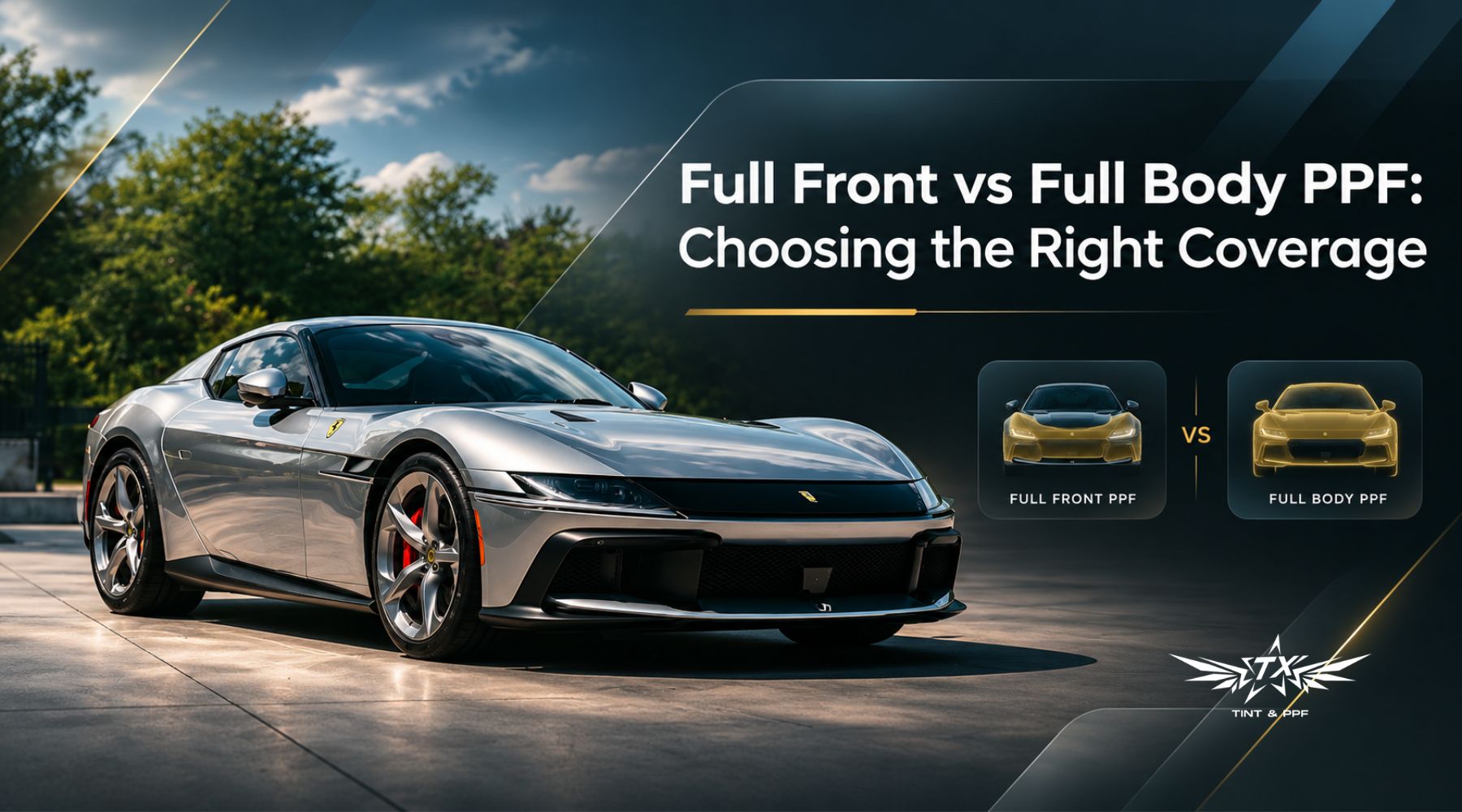
Full Front vs Full Body PPF: Choosing the Right Coverage
PPF COVERAGE • QUICK ANSWER
AUSTIN, TX
Choose the panels. Know what is covered.
Full front paint protection film (Paint protection film: a protective film applied to selected exterior surfaces.) focuses on the front of your vehicle. Full body PPF extends protection across its painted exterior. At TX Tint & PPF in Austin, the listed full frontal package covers the bumper, hood, fenders, mirrors and headlights. The track package adds Structural areas alongside the windshield. and The low body sections beneath the doors along the sides of a vehicle., while the full wrap package covers all painted surfaces.
Your choice comes down to the panels you care about, how you drive, and what the written quote includes. More film covers more surface area, but it cannot prevent every chip, scratch, or impact.
Explore Coverage Packages
Full Front vs Full Body PPF at a Glance
Package names vary, so compare the actual panels
instead of relying on labels. TX Tint lists
three levels of coverage:
01
Full frontal: focused front-end coverage
Listed Panels
Front bumper, hood, fenders,
side mirrors and headlights.
An owner who wants to prioritize the front
end instead of covering most of the car.
02
Track package: more coverage around exposed areas
Listed Panels
Everything in the full frontal package,
plus A-pillars and rocker panels.
Not Listed
Complete door, roof and rear-body coverage.
Practical Fit
An owner who wants more protection in
selected areas without choosing film
over all painted panels.
03
Full wrap: coverage across painted surfaces
Listed Coverage
All painted surfaces, including painted
panels beyond the front end.
Confirm Separately
Headlights, glass, unpainted trim and any
specialty surfaces. They are not automatically
established by the phrase
"all painted surfaces."
Practical Fit
An owner who wants broader, more consistent
protection across the painted body.
What Full Front PPF Covers and What It Leaves Exposed
The bumper, hood, front fenders, and mirrors are among the areas exposed to road debris. PPF adds a physical layer over these surfaces and may help reduce small stone chips and light abrasion. Results depend on the film and the force of the impact.
TX Tint's full frontal package also lists headlight coverage, which is worth checking when you compare proposals. Another installer might use the words "full front" while defining its panel list differently.
A protected hood does nothing for a door without film. TX Tint's published full frontal package also does not list rocker panels, A-pillars, the rear bumper, or the roof. If those areas concern you, ask about adding specific panels before moving straight to a complete wrap.
Also confirm whether "hood" and "fenders" refer to the exact full-panel boundaries you expect on your vehicle. Contours, trim and available film patterns can affect where an installer places seams or ends the film. A written coverage diagram is more useful than a vague package name.
Where the Track Package Fits Between Full Front and Full Body
TX Tint's track package takes the published full frontal coverage and adds the A-pillars and rocker panels.
A-pillars are the structural areas alongside the windshield. Rocker panels run low along the sides of the car beneath the doors. Covering these parts extends the protected area beyond the vehicle's nose, which can appeal to drivers concerned about wear around the windshield sides and lower body.
The track package offers a middle ground. You can cover these additional areas without wrapping every painted door, quarter panel, and rear surface. Despite its name, the package does not guarantee protection against damage during track use or high-speed driving.
Before choosing it, check whether rocker-panel coverage extends into the lower doors. Ask for those boundaries to be shown in the quote.
What Full Body PPF Covers
TX Tint describes its full wrap package as covering all painted surfaces. That includes more than the front end, such as painted doors, roof panels, rear quarter panels, the trunk or tailgate, and the painted rear bumper.
A full wrap leaves fewer painted panels exposed. That may appeal to someone concerned about scuffs during everyday use, keeping a car for several years, or maintaining a consistent appearance across the painted body.
Full body does not necessarily mean every exterior component. Headlights, glass, wheels, and unpainted trim are not painted body panels. TX Tint specifically lists headlights in its full frontal and track packages, but describes full wrap as "all painted surfaces." Confirm whether headlight film, spoilers, specialty finishes, or trim are included in your full-body quote.
Broad coverage also does not mean stronger film at each location. It changes how much of the vehicle is covered. Film selection, proper application and the nature of the damage still matter.
Choose Coverage by Driving Habits
Which PPF Coverage Makes Sense for Your Driving?
Scenario 01 | City Driving
For an everyday city driver
If your main concern is protecting
forward-facing paint from road grit,
full frontal coverage is a practical
place to start. You can prioritize
the panels TX Tint lists while leaving
the rest of the car unfilmed.
Think about what bothers you most.
If small marks around door handles or
lower doors are a bigger concern than
the rear quarter panels, a tailored quote
for selected additions may make more sense
than choosing a package solely by name.
Scenario 02 | Highway Driving
For someone who spends plenty
of time on highways
Highway driving can put a vehicle near
loose grit and stones, but conditions
change from trip to trip. Full frontal
PPF covers many of the forward-facing
areas owners commonly want to protect.
If lower-body paint and the areas beside
the windshield also concern you, compare
the track package. Its rocker-panel and
A-pillar additions may matter more to you
than film on every painted panel. That
does not make full body coverage necessary
for every commuter.
Scenario 03 | Long-Term Ownership
For an enthusiast or long-term owner
Full body coverage may appeal if you
want film across a much larger share
of the exterior paint, not just the front.
It can be useful for someone who pays
close attention to cosmetic condition
or wants broad coverage on a vehicle
they plan to keep.
Covering more panels generally requires
more film, preparation, and installation
work. Whether that extra coverage makes
sense depends on the car, its paint
condition, and your priorities. Compare
exact coverage rather than relying on
promises about resale value.
Make a Panel Priority List
Walk around the car and identify three groups:
the panels you most want covered, the panels
you would like covered if the quote allows,
and the panels you are comfortable leaving exposed.
That gives the installer a more useful starting
point than saying only "I want PPF."
Your PPF Quote Approval Checklist
Five Things to Check Before You Approve a PPF Quote
Check each item as you review the proposed
coverage and installation details.
What PPF Can and Cannot Protect Against
PPF is designed as a protective layer for the surfaces where it is applied. Depending on the film, it can help reduce damage from small chips and mild abrasion. Some films also have topcoats that can recover from shallow surface marks with warmth.
That protection has limits. Sharp or severe impacts can cut through film or damage the paint underneath. Deep cuts may not self-heal, and uncovered paint is still exposed. Full body coverage gives the film more places to help, but it does not make the car scratch-proof, chip-proof or accident-proof.
If you are comparing materials, XPEL’s paint protection film options explain the available product categories. Ask TX Tint to identify the exact material proposed for your car rather than assuming every product has identical properties.
Get a Quote Based on the Panels You Want Protected
Full frontal coverage focuses on the front end. A track package adds selected side and windshield-adjacent areas. Full body extends coverage across painted exterior panels. None is automatically the best fit for every Austin driver.
Frequently Asked Questions
Frequently Asked Questions About PPF Coverage
Does full front PPF protect the doors?
Not under TX Tint's published full frontal panel list. That package names the bumper, hood, fenders, mirrors and headlights. If door protection matters to you, ask whether individual doors, door cups or edges can be added to your quote.
What does the track PPF package add?
TX Tint's listed track package adds A-pillars and rocker panels to its full frontal coverage. It gives you an intermediate option, rather than requiring all painted surfaces to receive film.
Does full body PPF include headlights?
Do not assume so from the package name. TX Tint describes full wrap as covering all painted surfaces, while its full frontal and track packages specifically name headlights. Have the installer identify headlight coverage on the written full-body quote.
Can you customize PPF coverage instead of choosing a standard package?
TX Tint invites customers to inquire about customized protection. Ask which extra panels can be included on your particular vehicle and how those additions affect the final scope.
Will full body PPF stop every rock chip?
No. Full body coverage leaves less painted area exposed, but sharp or severe impacts can still damage the film and the paint beneath it.